top of page
Search
  • Writer: The Tiny White Shoebox
    The Tiny White Shoebox
  • Mar 16, 2020
  • 6 min read

What scares us? I would bet that as an adult it’s a little different from the fears in your childhood years. Most people’s biggest fear isn’t the dark, or monsters, or bugs. Most people fear money, and the problems and burdens that are associated with it.


Money isn’t inherently evil or particularly frightening. After all, it’s just coins and pieces of green paper. But we learn fairly quickly moving into our adult years that lacking funds is a terrible predicament to be in. I come from an average income household. My parent’s both grew up in Southern Ohio and never had anything handed to them during their childhood. Both learned to work hard for what they had at a very young age. They cherished and took care of the things that they earned. Practicality in life was a way of survival. They learned to be resourceful, frugal, and make calculated decisions in order to stretch a dime. They knew they wanted to be able to always provide for their future families and wanted to ensure their children had the best life possible.


My parents consistently preached to us about saving and not spending frivolously, from a very young age. They were always making us practice our math skills so that we would understand finances later in life. They wanted us to be fully educated and aware of when something was a good deal and when other things in life were scams, just trying to take our money. They were always so transparent and honest with us when it came to where our family stood financially. Things we could afford, things we couldn’t afford, things that we needed to save money for, unexpected financial burdens, etc. There was never a moment that I remember my parents trying to hide their financial truth from us. They never pretended to have more money than they actually had.


And still, I didn’t fully grasp the importance of understanding, planning, and preparing for life financially. I remember wondering why my mom wouldn’t let us buy things like expensive clothes or toys at the store. After all, she had a credit card. A credit card, as far as I could see, was free money; money someone gave you that allowed you to have things you wanted.


Let me tell you about my childhood with my parents. I have an older brother, who from birth was constantly hospitalized for numerous health conditions. I have a younger sister, who had more energy than most adults could handle. There was a lot of yelling. Along with the yelling, there was ALWAYS teaching. Reflecting back on being younger, I can’t remember a time that my parents weren’t trying to prepare us, teach us, or guide us. My parents were present. They spent quality time with us every single day. They were building a foundation. A foundation for a lesson that I would need to utilize for the rest of my life. And still, I chose my own path, my own way… I made my own choices.


In college, people tell you that “this is your time to be selfish”. I think this sends a dangerous message, if left at just that. During my college years, I began making quick, unreserved decisions about my life. I lived in the now, while thinking to myself that the choices I was making were fine… after all, everyone else was living their lives the same way that I was. If you felt unsatisfied, quickly find something that will give you instant gratification. It was what everyone else was doing. I was being a normal college kid. My parents and I fought a lot while I was in college. I was unfocused with school, having fun with my friends, spending all my earnings from every paycheck, taking out student loans to afford to live in crappy housing on campus so that I could get the “full college experience”. This is what society tells us that the college years are all about.


I didn’t accumulate as much student loan debt as most of my peers, so I considered myself “lucky”. When my friends graduated, their student loan payments were upwards of $400 monthly, when mine were just going to be $150. I felt so fortunate. At the time, I was burnt out from the array of classes I was taking just trying to find a major that would stick, when I found a job at a corporate bank working a night shift making $18 hourly. I left college and began working full time.


After working for about 6 months, I decided to buy myself a new car. My parent’s car that I had been driving was approaching 300k miles, and what the heck?! I deserved it! So, I went to a car dealership, handed over all the savings I had from the money I was making at my big girl job, and walked away with my first new vehicle, and a pretty new 5 year car loan.


I want to stop here and explain to you my mindset at this time. I was constantly comparing my financial situation to others', in order to get the reassurance I needed to sleep well at night with my decisions. Instead of solely looking at what I needed, what I should be planning for, what I should be worried about, I was looking to other’s lives as a model for my own. The problem with this is pretty simple… I was me, not them. As long as I had someone to look at and say, “Well, I must be doing ok because my situation isn’t as bad as theirs”, then I felt like there wasn’t anything wrong with what I was doing and the way I was living. But money still worried me. I would lay in bed at night, going back and forth with my thoughts. I would wonder why I had to constantly think about money, if I was going to have enough to buy myself groceries, if I had to pay the electric bill a few days late once I got paid, if I could afford to go on weekend trips with my friends. Why did I feel like this? I didn’t have “that much debt”. I had a “decent” job. I was making “good money”.


The thing is, most of us know what we are supposed to do with money, in a basic sense. The difference between people who don’t have to worry about money and those who do, is the habits and behaviors we have in place for our lives day to day.


I was fixating on outside surrounding factors that had nothing to do with my own behaviors; behaviors that were getting in the way of my own financial security and peace of mind. New purses, expensive bar tabs, emotional spending, eating out frequently, the list goes on of all the things that contributed to my financial anxieties. I didn’t have a plan, I was just living day by day, week by week, with no goals, no vision, and no idea how to build a positive future for myself. And the things I was spending my money on didn’t make me feel any more fulfilled, any more at peace, or any more accomplished. I had meaningless material things, and a mountain of stress and anxieties in front of me.


Take a step back with me here…


When I was a teen, I remember my parents started attending a class at our church called, “Financial Peace”. I didn’t know much about it, other than the fact that they started putting their cash every week in envelopes labeled with different categories. They said they were “budgeting” and following Dave Ramsey’s financial teachings. I didn’t like this Dave Ramsey guy and his advice, because it resulted in my parents saying “no” to us more. My parents who were always very frugal, were now going to an extreme in my eyes, to save money.

It was only recently that I realized the sacrifice my parents made back then was one of the best decisions they could have made for themselves and our family. After completing Financial Peace University, my parents paid off their 30 year mortgage in just 10 years. They have no debt. ZERO. ZILCH. NADA.


And do you know what recently happened to me, in my own adult years? I got tired. SICK AND TIRED. Tired of constantly feeling stressed about money. Sick of feeling like all I was doing was working and working and working and I had nothing to show for it. I was over feeling anxiety and fear about my future. I GOT HUNGRY. Hungry for a better life for myself. I wanted to feel peace of mind and I knew I had to take control of my life and get serious about my finances. So, I went back and humbled myself and began my journey to becoming debt-free.


Stay tuned for part 2 of my story!


  • Writer: The Tiny White Shoebox
    The Tiny White Shoebox
  • Feb 12, 2019
  • 6 min read

Updated: Feb 12, 2019

Ok y'all, this is my first ever tutorial so bare with me! I'm really nervous about this post, as I've never done anything like this before, but here goes nothing!


Drew and I have 2 dogs. Sampson, the big brown mutt; 5 years old, loves napping, napping, and more napping. Klaus, the purebred German Shepherd; 1.5 years old, loves protecting our house, running our house, and sometimes chewing our house. And so, since he is still a puppy even though he is full grown in size, we have to keep him crated whenever we leave the house.


Hence, the issue at hand.


My house is a little over 800 square feet and I don't even have enough room for a kitchen table in my kitchen, let alone a giant wire dog crate. Nor do I like sitting on my couch with front row view of puppy jail. We tried to put the crate in different corners of the living area, but it always stuck out like a sore thumb. I had seen people with dog crates built into end tables or TV stands, but the price that merchants were selling them for were upwards of $1000, and that wasn't in my budget. So I asked Drew if we could try to make one ourselves, with a few alterations, and of course he said he'd give it a go.


So without further adieu, here are the build plans for our dog crate console table, with removable crate option!


Materials needed:

- 15 pine 2 x 4's

- 7 48 inch planks/slats 2 inches wide each (we used poplar)

- 1.5 inch pocket hole screws

- Kreg Jig Kit

- Wood clamps (various sizes)

- Miter Saw

- Impact Driver Drill

- Orbital Sander

- Nail gun and nails

- Wood Stain/Paint

- Fabric/curtains

- Planer (optional, but helpful)

- Decorative finishing pieces (optional)


Tips before you get started:

- We used our planer to make sure all the 2 x 4's were as straight as we could get them before we got started. This is a lengthy process, but it definitely pays off at the end when your piece looks a lot more professionally crafted.

- Measure EVERYTHING! Measure, measure, and measure again. I drive Drew nuts with this, but we had a few mistakes when we didn't do this, and we avoided a few mistakes when we did.

- Our crate is HUGE! Klaus is 100 lbs and very tall for a German Shepherd. The crate we have is the Kong Wire Crate and it measures 43 in L x 29.5 in W x 30.5 in H. ... IF YOUR CRATE IS NOT THIS SIZE, YOU WILL NEED TO ALTER YOUR BUILD PLAN MEASUREMENTS ACCORDINGLY!!!!!!

- When you are drilling your pocket holes, remember that none of the pocket holes should be facing outward so that they can be seen on the outside of the table. All the pocket holes should be facing interiorly, which hides them.

- It helps to have a very large workspace, as this ends up being a very large piece. It can also get quite heavy to carry/difficult to get through certain doorways, so we brought the frame into the house before the table top was attached, and attached the table top to the frame once we had it inside.


Building The Frame:

- Cut 2 pieces of pine to 62 inches in length, and cut 2 pieces to 31 inches in length.

- Drill pocket holes using Kreg jig into the ends of the 2 smaller pieces. Use pocket hole screws to attach these pieces to the 2 larger pieces, forming a rectangle. This will be what your table top rests on. Measure from corner to corner diagonally to ensure that your measurements are precise.

- Cut 2 more pieces to 31 inches in length. Drill pocket holes into both ends of each of these pieces. These will serve as support pieces. Measure from one end of the rectangle to where the end of your dog crate would fit. For us, this was 43 inches. Attach one board in the rectangle at 43 inches, and the other at 17 inches. Your rectangle will now have sections dividing it. The area in the picture below highlighted in green should be what you now have.


Attaching The Legs:

- Cut 6 pieces 32 inches (height of legs).

- Drill pocket holes into one end of each "leg".

- Screw 4 legs into the frame's 4 corners with pocket hole screws. The pocket holes should all be facing the inside of the frame. The narrow side of the boards should be facing the front and back of the table.

- Screw in the remaining 2 legs to the part of the frame that will separate the area for the dog crate and the area for the shelving. For us, this was the 43 inch part.

- You should now be able to slide your dog crate in and out of the area you have built for it, and it isn't a bad idea to bring your crate out and test this to be sure.

- Cut 2 pieces 14.5 inches in length. These are the pieces your smaller planks will rest on and be nailed to when you are making the shelf part of the table.

- Drill pocket holes in both ends of each piece.

- Attach each piece with pocket hole screws to the 4 legs where shelving will go at your desired shelf height. One piece can be seen on the front and one will be on the back. I wanted to be able to fit a basket underneath on the floor, so just keep anything like that in mind when you are making this decision.

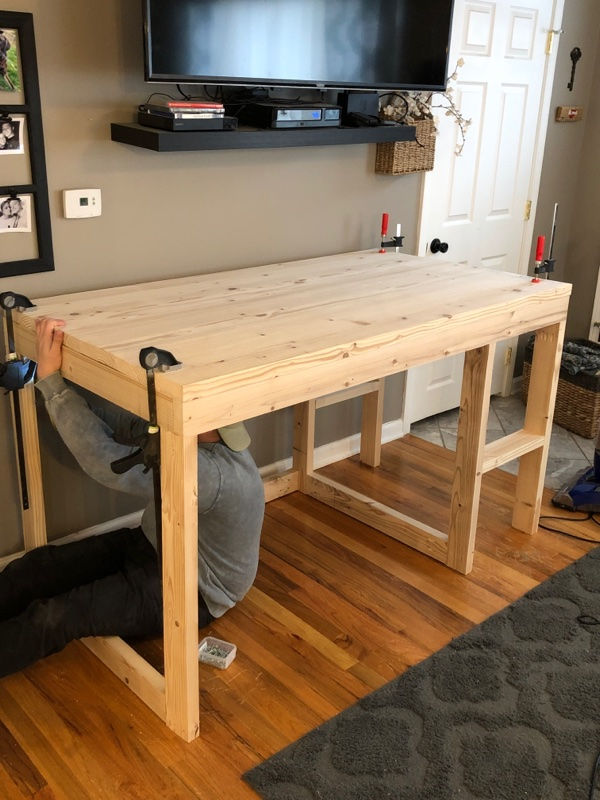
- Your table should now look like this...


Building The Table Top:

- Cut 10 pieces of 2x4's to 63 inches. It is important to be exact on these measurements, so that you don't have to sand down the sides of the table top for days on end.

- Decide which side of the boards you want to be the top of your table and which sides you want facing down. Mark the side you want on the top with a letter T. You will not be drilling the pocket holes on the "T" side.

- Place your boards "T" side up in the order you want them to go. I'm very particular about how I want things to look so I made sure all the different levels of grain were spread out, but this is all totally your preference.

- Once you have your boards place how you want them, flip them all over to the side you will be drilling the pocket holes into. Drew drilled pocket holes in each board on each end and in the center of the boards. You want to make sure you are drilling the holes so that you can pull the boards together, so don't drill them in the exact same spot on each board. The table top should look like a picnic table top, and you are attaching them together in that manner.

- Clamp the 2nd board down and screw the first board to the second board, making sure the ends of the boards line up as evenly as you can make them.

- Repeat this process until all 10 boards are attached to each other and you now have a sheet of wood that looks like a table top.

- Sand the table top as desired starting with a lower grit (we used 60) and moving to a higher grit second (we used 220).

- Take a mobile Kreg jig and secure it to the table frame where you want to attach the table top. You will be drilling the holes up through the rectangle to the top of the frame. We put our pocket holes in all 4 corners of the frame.

- Place your table top as you want it to sit on your frame. You should have some overhang on the sides. Once you have it in place, clamp all 4 corners to the frame and screw pocket hole screws into the pocket holes from underneath.

- You can add extra supports, which we decided to do later, at the bottom of the area where the dog crate sits, on the back and sides.

- Your table should now look like this...


Building The Shelf:

- Cut your 2 inch planks to 33.75 inches in length. You will need 6-7 planks. We used a nail gun and just nailed each plank to the shelf support boards.


AND THAT'S IT! After that you just stain and/or paint as you want and attach fabric/curtains and any decorative pieces that you want to finish it off with! I am obsessed already, and I hope this tutorial was helpful for those of you who have been asking how we did this!!


  • Writer: The Tiny White Shoebox
    The Tiny White Shoebox
  • Jan 27, 2019
  • 5 min read

Updated: Jan 28, 2019

It was about 6 months ago that I finally got Drew to sit down with me, keep his phone in the locked position, and actually watch an episode of my favorite television show, "Fixer Upper". From the corner of my eye, I watched his jaw clenching, as he tried to hide his complete skepticism and boredom from showing on his face. I asked him the typical questions we females ask our beaus in instances like this...


N: "Do you like that shiplap?"

D: "Sure."

N: "That farmhouse sink is gorgeous, I love mine but I wish I would have spent a little more and bought a sink more like that one."

D: "Yeah."

N: "Chip is a nut job. You can tell he's a great guy, though. I bet you five bucks that he's going to show up to the fixer upper with another puppy when he drops off the kids."

D: "Probably."

N: "Do you know what shiplap is?"

D: "Nope."


... *sigh*...


And so, we watched another.


And another. And we continued this process for a few evenings. Every night, we would eat dinner and then return to the couch. Drew would ask me what I wanted to watch, hoping and praying I would cave and allow him to throw on something more his speed... a hockey game... a soccer game... a chess game... anything but Fixer Upper.


The thing is, Drew and I met while working at a bar. When we started out bartending together, I noticed something about him. Drew was meticulous with details. He never missed an empty glass or a spill. Every person who walked into the bar, walked in loving Drew or they walked out loving him if they had not met him before that night. He now claims he was only trying to impress me; to show me his bartending mastery and prove himself worthy of my affections. But, I know it was more than that. Drew took pride in his work. He never showed up to just slack off. He busted his butt from the moment he walked into a shift, until he locked up the bar doors behind him. Whether he was just doing it to impress me or he was doing it because that's how he's wired, I'll probably never know. What I do know is that it worked; I was impressed.


And so, I knew if I could get him to look past the frills and flowery designs, he was a Chip Gaines at heart. The more episodes we watched, the more interest he took in the subject matter, without me having to pull it out of him. He told me that his grandpa was always doing woodworking when he was a kid, and started showing me different designs for outdoor pergolas on Pinterest. I started sharing how I made decisions about my house when I first got it, and showed him Instagram pictures of homes that had style similar to my own.


We. Were. Hooked.


The more we watched, the more ideas we got, and the more Drew wanted to help me create a home that would make me happy. He built me a beautiful pergola in our backyard this past summer as my birthday present, and I think that was when I realized the full capacity of his talents.


This story is nice and all, but it's not my reasoning behind writing this post.


Drew was equally impressed by my design sense, my taste in decor, my knowledge of renovations, etc. This actually ended up making me feel a bit pressured to keep up with everything. New people were coming over to my house; his friends, his family, people from his world, all of whom haven't known me for almost 30 years. People who have known me forever might grant me grace when my home is a pigsty. I think sometimes as homemakers, we can get caught in a web of trying to achieve perfection in the eyes of others, especially when it comes to home presentation. Drew quickly saw how stressed I would get before guests would arrive for parties, for dinner, even just to pick up something small that they may have forgotten during a previous visit. He acted like it was no big deal, that I needed to relax, but I just couldn't. We have 2 large dogs, who shed A LOT. Sidenote: Until you have a dog who sheds, you have no idea how important a good vacuum cleaner is to a home.


And the dishes. THE DISHES. Don't even get me started on the dishes! I have a farmhouse sink... a sink that 30 years ago, people were probably ripping out of their kitchens and throwing in the garbage, only to replace with it something else; something more expensive, that folks at the time just had to have. And yet, I wanted this sink specifically, to help round out my picture-perfect kitchen. So, when dirty dishes accumulate in my farmhouse sink, every inch of my body shudders with disgust.


Let's get real right now. I mean, let's get FO' REAL, FO' REAL.


The morning after I published my first post on here, this is what my beautiful, pretty, magazine-esque, farmhouse sink looked like...


This is how my sink looks 70% of the time. The point of me sharing this (and make sure you're sitting down because this may come as a shock to some of you), is this... no one is perfect.


Try not to let yourself become envious of your friend who's home is always pristine. You have no idea how long she's been nagging her husband to just take the freaking trash out and how much he resents her for it. How many of us get our best cleaning done 20 minutes before guests arrive? I'm raising my hand.


I've been mean to Drew more times than I'd like to admit because of superficial standards that I let seep so quickly into my mind. Does this mean it's ok to live like total slobs? No. I take pride in my home and the work I've put into maintaining it and I will always hold steadfast to that mindset. However, the memories made are more important and make up the true atmosphere of a home, not the curtains.


I'll never forget one night when we were watching Fixer Upper, both with Bud Light cans in our hands, and the episode ended. Drew looked at me and said, "Ok, I liked that one and all, but I just have one question... Where are the TV's? They never have TV's in these homes when they are presenting them. Don't these people watch TV?" I just looked at him, rolling my eyes. But in the back of my mind, I went back to a moment when I was watching the same show with my parents at their house, AND MY DAD MADE THE SAME EXACT STATEMENT.


We all have TV's. They aren't pretty; they are an eyesore. But we all have them.


Don't you ever forget that.


bottom of page